
Can a wallet predict your losses? How transaction simulation changes risk calculus for DeFi power users
What if the next NFT sale, DEX swap, or yield harvest you sign could be run in a sandbox and reported back to you in clear numbers before you ever press confirm? That is the claim behind transaction simulation features in modern browser wallets, and it matters because the real risk in DeFi is not only malicious code but predictable, avoidable mistakes. For active DeFi users—traders, LPs, arbitrageurs, and treasury managers—simulating a transaction is a different kind of defense: it translates abstract blockchain state changes into the concrete currency-and-token deltas that you can reason about.
This article explains how transaction simulation works at a mechanism level, what Rabby does differently, the remaining blind spots you should care about, and practical heuristics for folding simulation into your operational discipline. The goal is not to praise a product but to give you a mental model you can use when deciding whether to rely on any wallet’s “preview” before signing a high-value operation in the US DeFi ecosystem.
How transaction simulation works — the mechanism behind the preview
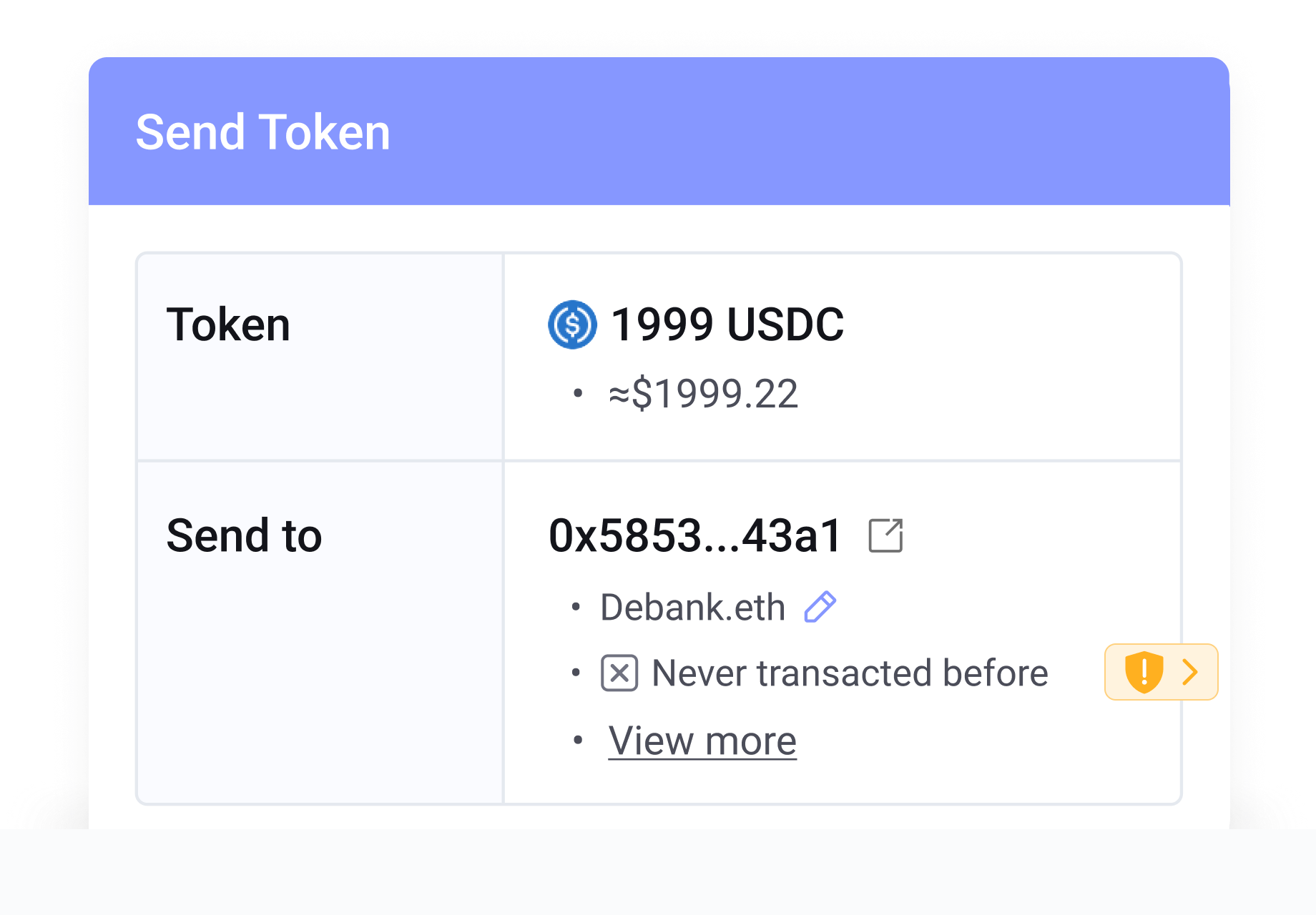
At its simplest, transaction simulation replays a proposed transaction against a copy of the chain state without broadcasting it. The wallet constructs the exact call data and sender context you would sign, then queries a node or an integrated simulation engine to execute the call locally. The result is a deterministic readout of state changes: token transfers, events emitted, gas consumed, and whether the transaction would revert. Good simulations also show the estimated gas fee in the native currency and the net token balance changes across affected assets.
Why is this stronger than surface-level checks like reading the method name? Because many harmful flows exploit composition: a benign-looking approve() followed by a second call that drains tokens, or a contract that performs unexpected internal swaps. Simulation reveals the composed effect of all internal calls and fallback logic, not just the top-level method signature. That makes it a valuable tool for avoiding blind signing—the practice of approving transactions without knowing their full effect.
Rabby’s approach: simulation plus layered pre-transaction scanning
Rabby’s distinguishing claim is combining a pre-transaction risk engine with simulation outputs. Before signing, the extension runs automated scans that flag known hacked contracts, suspicious approval requests, and non-existent recipients. It then simulates the exact transaction and reports the estimated token balance changes and fee costs. Because Rabby supports automatic network switching and over 90 EVM-compatible chains, those simulations must handle many RPC endpoints and chain idiosyncrasies—a nontrivial engineering task.
For readers evaluating wallets, note one operational advantage: Rabby’s simulation outputs are designed to be actionable (net token delta, fee estimate) rather than purely technical logs. That matters when you’re multitasking or under time pressure during volatile market windows. If you want to explore Rabby’s implementation and install options, see this resource for the extension: rabby wallet.
Myth-busting: what simulation can and cannot guarantee
Misconception 1 — “Simulation makes transactions safe.” Simulation reduces risk, but it is not a silver bullet. It can detect many classes of mistakes and malicious flows that are expressible in the simulated environment, but it depends on the node state snapshot, the RPC endpoint used, and the fidelity of contract artifacts. If a dApp relies on off-chain signatures, or an oracle value changes between simulation and on-chain inclusion, the real execution can differ.
Misconception 2 — “All wallets simulate the same way.” They do not. Differences include the RPC endpoints used (public vs. proprietary), whether simulation includes pending mempool state, how internal calls are decoded for readable output, and whether the wallet warns about approvals by default. Rabby differentiates by integrating a risk scanner and by making the simulation result explicit in human-readable token deltas.
Misconception 3 — “Simulations protect against freshly deployed zero-day hacks.” Not reliably. Simulation detects immediate technical behavior, but it cannot anticipate sophisticated social-engineering lures, off-chain compromise of private keys, or exploits that rely on network state that changes between simulation and mining. Rabby’s 2022 incident with Rabby Swap shows this reality: even projects that emphasize security can experience contract-level vulnerabilities. The response—freezing the contract and compensating users—illustrates mitigation after failure, not prevention in every case.
Trade-offs and limitations: where simulation helps and where it doesn’t
Operational trade-off: simulation increases confidence but can add friction. For high-frequency or time-sensitive operations, waiting for a full simulation and human review may reduce alpha or require pre-approved scripts. That friction is a deliberate security trade-off; the alternative is speed at the cost of blind signing risk.
Technical limitation: simulations are only as good as the chain snapshot and decoding. Some chains or RPC providers rate-limit or return inconsistent traces, which can produce incomplete outputs. Cross-chain operations introduce further complexity: cross-chain bridges often require off-chain relayer actions not captured by a single-chain simulation. Rabby’s cross-chain gas top-up and multi-chain support help in practical terms, but even the best wallet cannot perfectly simulate a multi-step bridge process that depends on external relayers.
Institutional boundary condition: for treasury or custodial setups, simulation is one piece of a multi-layered control regime. Rabby integrates with multi-sig and enterprise services (Gnosis Safe, Fireblocks, Amber, Cobo) so teams can combine simulation-derived evidence with policy-enforced approvals. But teams should still rely on multi-sig thresholds, contract vetting, and offline key custody as primary controls.
How to use simulation as part of a defensible DeFi workflow
Adopt a three-layer habit: (1) surface checks — who is requesting approval, what ERC20/721 method is invoked, and whether the recipient address is known; (2) run simulation — insist on explicit token delta and fee numbers; (3) contextual verification — cross-check the dApp contract address on block explorers, review recent audits or alerts, and, for large amounts, replicate the call in a cold environment or require multi-sig confirmation.
Heuristic: Treat any approval that grants unlimited allowance as high-risk. If simulation shows a subsequent internal transfer to an address you do not recognize, pause. Use Rabby’s built-in approval revocation tool regularly to clear allowances you no longer need. For US users and teams, document approvals in treasury logs and require a secondary reviewer for transfers above a defined threshold.
What to watch next — conditional scenarios and signals
Signal 1 — wider adoption of simulation standards: if more wallets standardize trace outputs and simulation APIs, tooling for automated policy enforcement (e.g., pre-approval rules) will become practical. That would allow enterprise users to codify “do not sign” policies across wallets.
Signal 2 — better oracle/time-of-execution handling: wallets that incorporate mempool and oracle-sensitivity warnings (e.g., flagging simulation results that depend on a volatile price feed) will meaningfully reduce false confidence. Watch whether wallets begin to surface oracle staleness as an explicit risk in the simulation output.
Signal 3 — integration with L2/bridges: as multi-chain activity grows, the effectiveness of single-chain simulation will be tested. Tools that stitch simulations across chains or simulate the entire bridge lifecycle (including relayer delays) would close a notable gap for cross-chain operations.
FAQ
Does simulation prevent smart contract exploits?
No. Simulation can reveal how a particular call behaves against current state, which helps detect many malicious or unexpected flows before signing. But it cannot guarantee that a contract is free of vulnerabilities, nor can it protect against exploits that rely on external state changes or social-engineering compromising keys. Treat simulation as a powerful diagnostic, not an absolute shield.
How accurate are fee estimates in simulations?
Fee estimates are typically close but not exact. They depend on the gas price model, network congestion, and whether the transaction is included immediately or delayed. Simulation provides a useful baseline for budgeting fees and avoiding surprise costs, but always allow a margin for higher gas during volatile periods.
Can simulation decode internal contract calls for me?
Yes—modern wallets attempt to decode internal calls and present readable outcomes (token transfers, swaps, approvals). The quality of decoding varies by wallet and by availability of contract ABIs. When decoding fails, a technically capable reviewer should inspect raw traces or reproduce the call in a local dev environment.
Should institutions rely on simulation instead of multi-sig?
No. Simulation complements but does not replace multi-sig and policy controls. For institutional risk management, combine simulation evidence with enforced multi-sig thresholds, hardware-backed key storage, and audit logs.
Decision-useful takeaway: treat transaction simulation as a high-value diagnostic that changes the question from “Do I trust this dApp?” to “What exactly happens to my balances if I execute this now?” Use simulation outputs to translate smart contract opacity into numeric deltas you can reason about, fold them into multi-sig or review policies, and watch for signals—like improved cross-chain simulation and oracle-awareness—that will determine whether previews become reliably predictive rather than merely informative.